Mold Remediation in Boise, ID
Mold remediation in Boise, ID starts with one call to (856) 595-8837. A support manager takes the details and confirms a booking time with you. A local specialist from our network then contacts you quickly, sometimes the same day, and gives the estimate on the call. The work covers inspection, containment, removal of moldy material and the fix for the water source, from crawl space to attic.
- One call, no forms to fill out
- Support manager available 24/7 to confirm your booking time
- A specialist contacts you quickly, sometimes the same day
- Free estimate and inspection, given on the call
- Licensed, insured and certified network technicians
- Help with insurance claims
- Written warranty on the work
- Independent clearance testing available
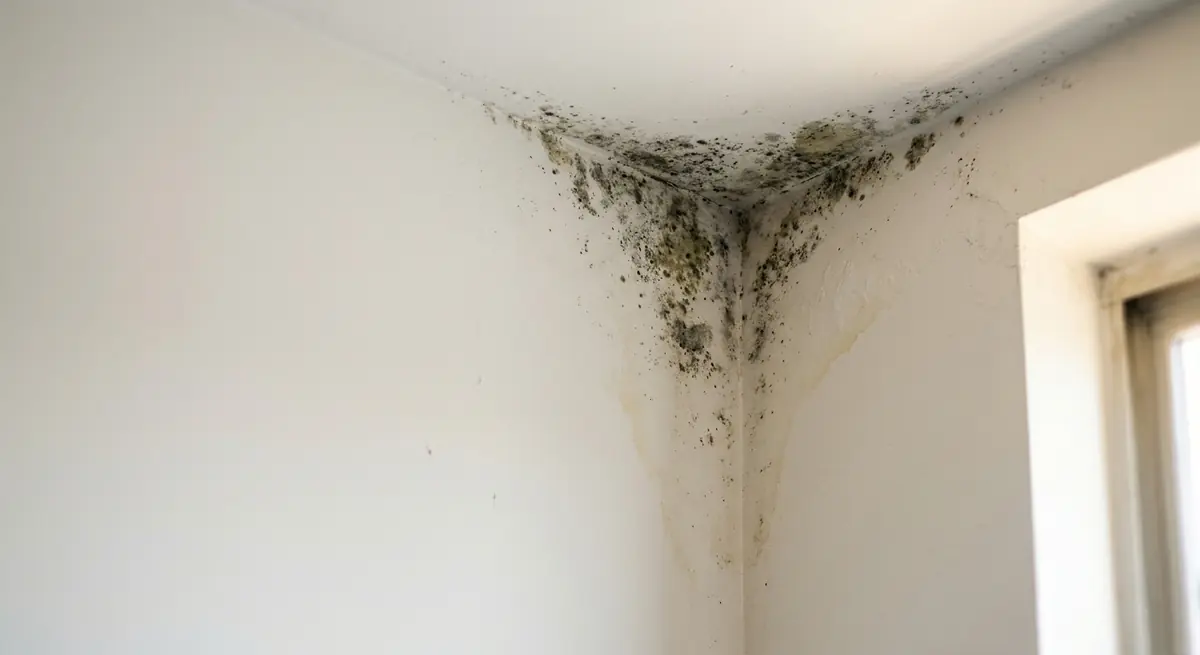
Speak to a support manager · confirm a booking time · get the estimate on the specialist's call
No name, phone or email needed. We count anonymous answers, never contact details, to improve this page.
On the call, say where the mold is, how large the area is, and the date of any leak or flood.
Mold Remediation Co. is a referral service. We connect you by phone with independent local mold remediation companies, and their technicians perform the work. We are not a contractor.
Quick recap
- Audience: Boise property owners with visible mold, a musty odor, or a recent leak or flood.
- Contact: one call to (856) 595-8837; a support manager confirms a booking time.
- Estimate: given by the local specialist on the call.
- Work: done by independent network technicians who are licensed, insured and certified.
- Coverage: 11 Boise ZIP (Zone Improvement Plan) codes plus Meridian, Nampa, Caldwell, Eagle, Garden City, Kuna, Star and 6 more nearby towns.
What happens when you call about mold in Boise?
A support manager answers, asks where the mold is and how large the area is, and confirms a booking time with you. A local mold specialist then contacts you quickly, sometimes the same day, and gives you the estimate during that call.
- Call (856) 595-8837 and describe the problem to the support manager.
- Confirm a booking time that works for you.
- Take the specialist's call and get the estimate on that call.
Before you call
- Note every room with visible growth or a musty odor: crawl space, attic, bathroom, under sinks.
- Estimate the affected area in square feet. The U.S. Environmental Protection Agency (EPA) uses about 10 sq ft, roughly 3 ft by 3 ft, as the line between homeowner cleanup and professional work.
- List any leak, burst pipe or flooding, with the date it happened.
- Mention anyone in the home with asthma, a mold allergy, a weakened immune system or chronic lung disease. The Centers for Disease Control and Prevention (CDC) names these groups as higher risk.
- Switch off a heating, ventilation and air conditioning (HVAC) system that smells musty. EPA advises against running that system if you know or suspect that it is contaminated with mold.
What drives mold growth in Boise homes?
Boise mold follows indoor water more than outdoor rain. Boise Air Terminal averages 11.5 inches of precipitation a year, so growth starts at leaking pipes, condensation on cold surfaces through a long heating season, and the occasional flood.
Dry air outside, wet spots inside
Boise Air Terminal, the NOAA climate-normals station at about 2,814 ft, averages 11.5 inches of precipitation a year (1991-2020 normals). Northwest Boise, served by the Boise 5.3 NW station at about 2,622 ft, averages 14.3 inches. The Boise 7 N station in the foothills above downtown, at about 3,885 ft, averages 18.0 inches. Ada County as a whole averages about 12 inches (NOAA nClimDiv, 1991-2020). ZIP 83716 reaches higher ground: its nearest normals station, Graham Guard Station at about 5,690 ft, averages 31.0 inches.
With that little rain, the water that feeds Boise mold comes from inside the house: a supply line that drips in the crawl space, a drain that leaks behind a vanity, or moist indoor air that condenses on a cold surface.
A long heating season means cold surfaces
A heating degree day counts how far a day's average temperature falls below 65°F. Boise Air Terminal records about 5,320 heating degree days a year and about 1,040 cooling degree days, so heating demand runs about 5 times cooling demand. The foothill station at Boise 7 N records about 6,170 heating degree days. Months of cold weather keep roof sheathing, crawl space framing and uninsulated pipes cold, and EPA lists condensation on cold surfaces and pipes as a moisture source behind indoor mold.
Flood claims concentrate downtown
Property owners in Boise's 9 residential covered ZIP codes have filed 73 National Flood Insurance Program (NFIP) claims since 1978, and 21 of them since 2016. ZIP 83702, which includes downtown, accounts for 36. Ada County has been included in 1 federal major disaster declaration since 2000, and it was a flood. ZIPs 83705, 83713 and 83716 show no NFIP claims; that record covers insured properties only and does not mean zero flood risk. EPA's rule after any flood or leak is to dry water-damaged areas and items within 24 to 48 hours to prevent mold growth.
Where does mold grow in Boise houses?
Boise mold grows first in 3 places: the crawl space under the floor, the attic under the roof, and wall cavities and cabinets around leaking pipes. All 3 hide growth from view until a musty odor, a stain or a soft floor appears.
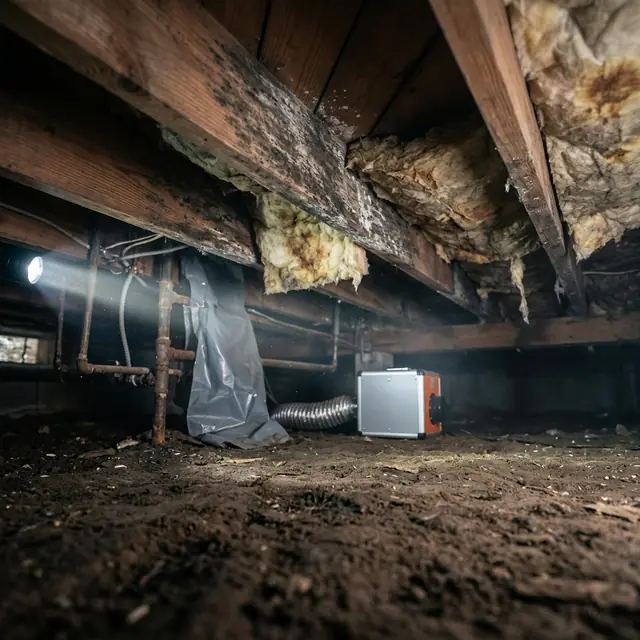
Crawl space mold
A crawl space puts supply lines, drain lines and the underside of the floor in a dark, closed space with little air movement. A slow leak there runs for weeks before anyone sees it, and the wood floor joists and subfloor above it absorb the water. The Boise specialist checks the joists, subfloor, insulation and any ductwork in the crawl space, finds the water source, and prices removal and drying together. Our guide to mold in a crawl space explains joists, moisture control and encapsulation in more detail.
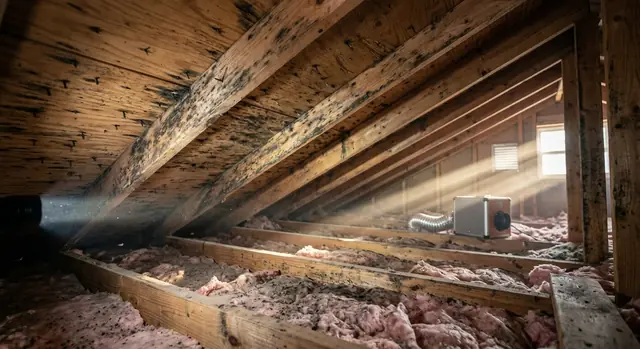
Attic mold
EPA names roof materials as a hidden-mold location, caused by roof leaks or insufficient insulation. In Boise's long heating season, warm indoor air that escapes into the attic meets cold roof sheathing and leaves moisture on it. The specialist inspects the sheathing, rafters and insulation, then checks the dryer vent, because EPA advises venting moisture-producing appliances such as clothes dryers to the outside.
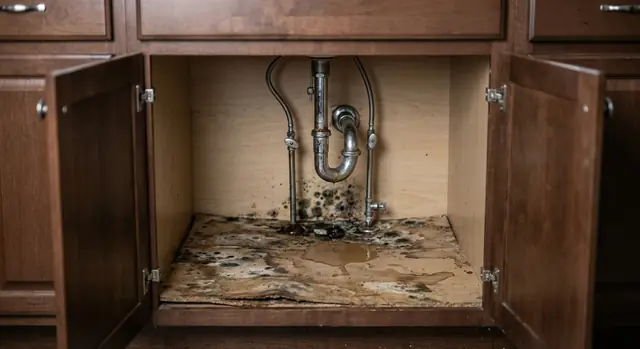
Plumbing-leak mold
EPA lists the inside of walls around pipes as a common hidden-mold location. In central Boise, including downtown 83702, a pinhole leak behind drywall or under a sink cabinet keeps the wall cavity wet long enough for growth. The specialist opens the wall only where moisture readings point, which keeps the removal area and the quote smaller.
Which materials does Boise crawl space and attic mold damage?
Crawl space and attic mold in Boise damages 5 materials: wood joists and subfloor, fiberglass and cellulose insulation, roof sheathing, drywall around pipes, and ductwork. Porous materials are removed when growth fills them; hard surfaces are cleaned and dried.
- Wood joists and subfloor
Crawl space framing absorbs water from leaks below the floor. EPA states that molds weaken floors as they feed on wet wood, so the quote states which members are cleaned and which are replaced.
- Insulation
Fiberglass and cellulose batts sit between crawl space joists and across the attic floor. EPA's water-damage table lists both for discard and replacement once wet, not drying.
- Roof sheathing
Attic sheathing is the first cold surface warm indoor air reaches in winter. EPA names roof materials as a hidden-mold location linked to roof leaks and insufficient insulation.
- Drywall
Gypsum board is porous. EPA advises against wet vacuums on it and treats moldy porous material as a removal item, because mold is hard to remove from it completely.
- Ductwork
Ducts run through Boise crawl spaces and attics. EPA lists the inside of ductwork as a hidden-mold location and advises against running a system you suspect is contaminated.
What are Idaho's rules for mold remediation?
No Idaho state law requires a mold inspection or sets a mold cleanup standard, according to the Idaho Department of Health and Welfare. Contractors register with the Idaho Division of Occupational and Professional Licenses for construction jobs over $2,000.
The Idaho Department of Health and Welfare (DHW) does not test or inspect homes for mold, and its mold page states that testing is not needed in most cases. For areas larger than 10 square feet, DHW points homeowners to a professional.
The Idaho Contractor Registration Act requires registration, not licensure. The Idaho Division of Occupational and Professional Licenses (DOPL) applies it to construction jobs over $2,000 in labor and materials. Ask the specialist for an Idaho contractor registration number when the quote includes tearing out or rebuilding drywall, insulation or subfloor.
What does mold remediation include in a Boise home?
Mold remediation includes 6 steps: an assessment of growth and moisture, containment of the work area, high-efficiency particulate air (HEPA) filtration, removal or cleaning of affected materials, repair of the water source, and a final check that the area is clean and dry.
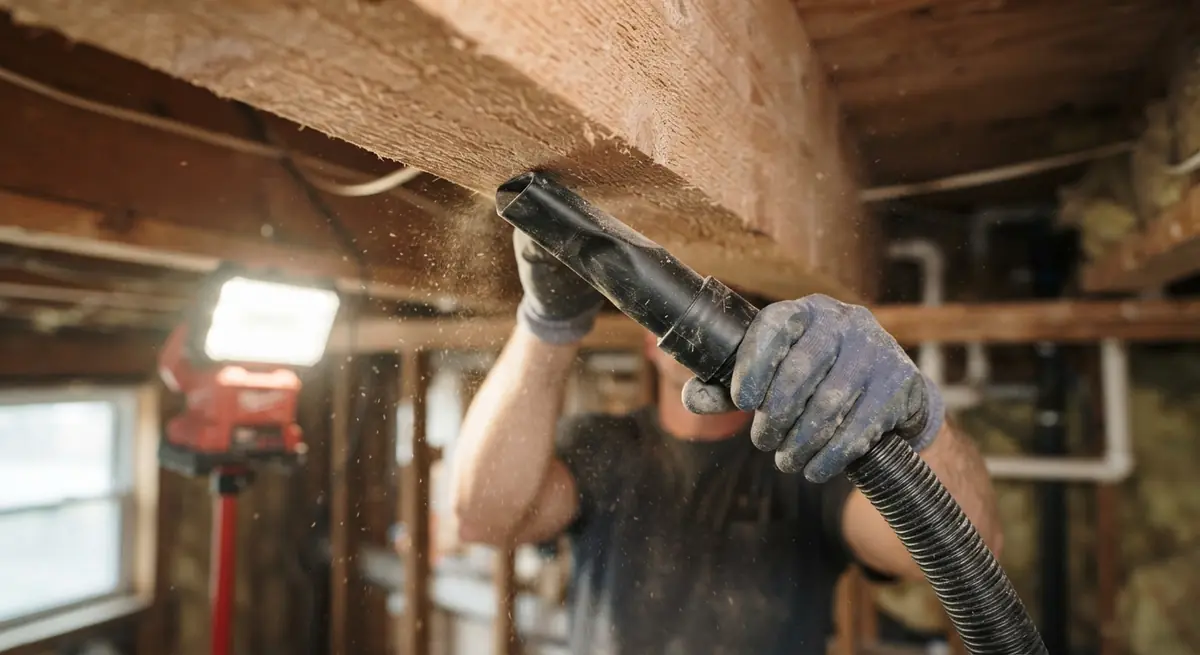
- Assessment: the specialist maps visible growth, takes moisture readings and finds the water source.
- Containment: plastic sheeting isolates the work area. EPA recommends limited containment for 10 to 100 sq ft of growth and full containment above 100 sq ft.
- Filtration: HEPA machines filter the air, and HEPA vacuums clean surfaces once materials are dry and removed.
- Removal: porous materials that mold has filled come out in sealed bags; hard, non-porous surfaces are scrubbed with detergent and water and dried completely.
- Repair: the leak, condensation point or drainage problem that fed the mold gets fixed.
- Verification: the work area is checked for remaining growth and moisture before rebuilding.
Does a Boise home need mold testing before remediation?
Most Boise homes need a visual inspection, not a lab test. CDC does not recommend mold testing, and the Idaho Department of Health and Welfare states that testing is not needed in most cases. Visible growth is removed whatever the species.
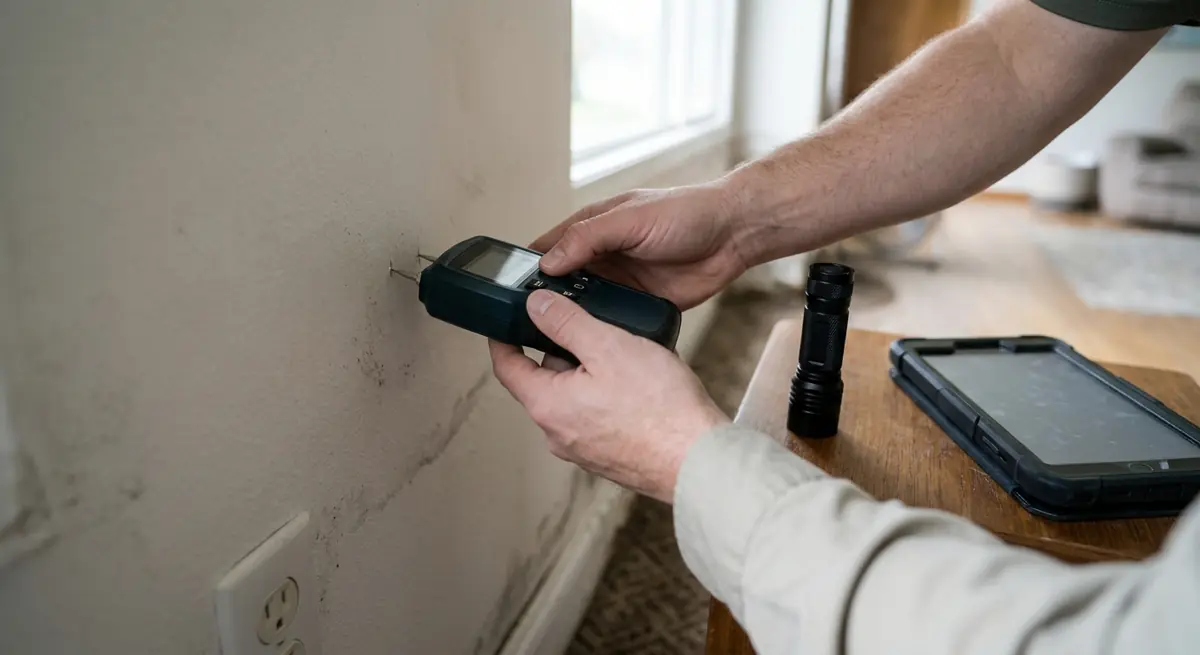
Sampling is justified in 2 situations: locating hidden growth behind a musty odor with no visible source, and confirming that a finished job passed clearance. CDC notes that no accepted standard defines an "acceptable" mold level in a home, so a spore count alone does not tell you whether to remediate. For assessor options, sampling methods and fees, see our page on mold inspection in Boise.
What changes the price of mold remediation in Boise?
Area in square feet sets the base of a Boise mold remediation price. Access, containment level, material removal, the water-source repair and clearance testing move it up or down. The local specialist gives you the estimate on the call.
A crawl space or attic job costs more to reach than the same area in an open room, because technicians work on their knees and bag debris out through a hatch. Published price ranges, Boise price drivers and a full line-item checklist sit on our page about mold removal cost in Boise.
A complete quote lists
- Area in square feet, room by room
- Containment type and HEPA equipment
- Materials to remove and materials to clean
- Water-source repair, or a note that a plumber or roofer handles it
- Clearance check, and who performs it
Red flags
- Self-clearance: one company tests, remediates and clears its own work with no independent check.
- Cash-only payment.
- Pressure to sign the same day based on the mold's color or species.
When is a Boise mold remediation job finished?
A Boise mold job is finished when 3 conditions hold: the water source is repaired, the affected materials are dry, and an independent clearance check confirms the work area is clean. Removal without the water-source repair lets the mold return.
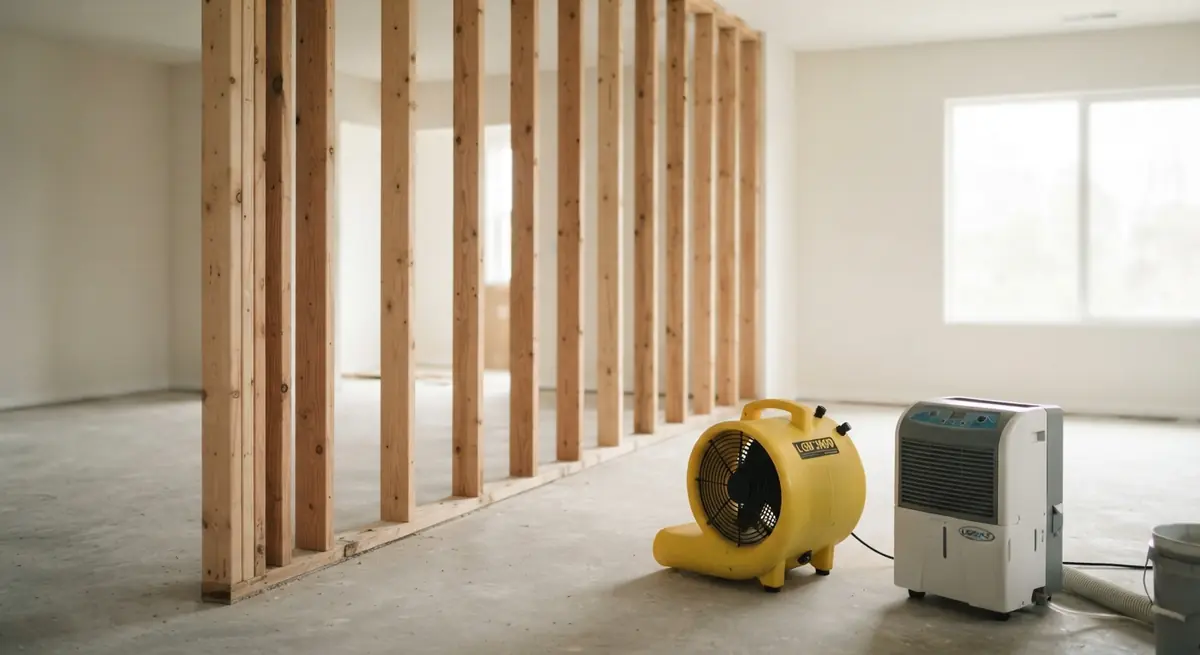
EPA states the rule directly: clean up the mold without fixing the water problem and the mold problem returns. In a Boise crawl space that means the leaking line is repaired and the subfloor reads dry before new insulation goes in. In an attic it means the roof leak or the unvented fan is fixed before the sheathing is sealed or replaced. Ask for the clearance result in writing before drywall, insulation or flooring goes back.
Which Boise ZIP codes and nearby towns are covered?
Our network covers 11 Boise ZIP codes: 83702, 83703, 83704, 83705, 83706, 83709, 83712, 83713, 83716, 83720 and 83725. Calls from 13 nearby towns are covered too, including Meridian, Nampa, Caldwell, Eagle, Garden City, Kuna and Star.
| Town | Covered ZIP codes |
|---|---|
| Meridian | 83642, 83646 |
| Nampa | 83651, 83686, 83687 |
| Caldwell | 83605, 83607 |
| Eagle | 83616 |
| Garden City | 83714 |
| Kuna | 83634 |
| Star | 83669 |
| Middleton | 83644 |
| Melba | 83641 |
| Greenleaf | 83626 |
| Notus | 83656 |
| Parma | 83660 |
| Wilder | 83676 |
Call about a ZIP code that is not listed, and the support manager tells you whether a specialist covers it.
Boise mold remediation FAQ
How fast does a mold specialist contact me in Boise?
A local specialist contacts you quickly after the support manager confirms your booking time, sometimes the same day. The specialist gives the estimate during that call, so scheduling and pricing both start on the first contact.
Is black mold removed differently in Boise?
No. CDC states there is no need to identify the type of mold: all visible growth is removed and the moisture source is fixed. Stachybotrys, the mold called black mold, goes through the same containment and removal steps.
Does homeowners insurance cover mold remediation?
Homeowners insurance covers mold only when a sudden covered event, such as a burst pipe, caused it. Flood damage, long-term leaks and high humidity fall outside standard coverage, and some policies cap mold payouts. Read your policy's mold limit first.
Can I clean a small patch of mold myself?
Yes, for patches under about 10 square feet, roughly 3 feet by 3 feet. EPA places that size within homeowner cleanup. Larger areas, sewage water, suspected HVAC contamination or health concerns call for a professional mold specialist instead.
How do I spot hidden mold in a Boise crawl space or attic?
A musty odor with no visible source is the main sign of hidden mold. Under a Boise house, look for a soft or stained subfloor. In the attic, look for dark staining on roof sheathing and damp insulation.
Mold in a Boise crawl space, attic or wall? Call (856) 595-8837. A support manager books your time, and a local specialist gives the estimate on the call.
Call (856) 595-8837